A scholarly look at why memory, personality, emotional intelligence, and motivation are the four things that make a character — or a person — feel real. And what cognitive science has to say about each of them.
The tavern keeper problem
Picture two tavern keepers. Both are characters in a game you’re playing, or in a novel you’re reading, or in an immersive world you’ve been invited to spend time in. Both pour you a drink, both take your coin, both say hello when you walk in.
The first one does nothing else. Every time you walk into the tavern, she gives you the same greeting. She doesn’t remember you. She doesn’t react to whether you saved her village last week or betrayed it. She has no opinions about the weather, no complaints about her back, no idea that the barrel of ale in the corner is cursed. She is, functionally, a vending machine for drinks wearing a person-shaped costume.
The second tavern keeper is also a character. Also pours drinks, also takes coin, also says hello. But she remembers that you helped her daughter recover from the fever six months ago, and her greeting is warmer because of it. She’s naturally cautious — when you ask about the cursed barrel, she weighs the question for a moment before answering, the way a cautious person would. She notices that you look tired tonight and pours you something a little stronger without being asked. And she wants something for herself, too, underneath all of this — she’s been saving up to buy out her brother-in-law’s share of the tavern, because she thinks she could run it better alone, and that ambition colors everything she does.
You know which tavern keeper is the memorable one. You also know which one is more expensive and time-consuming to build, whether you’re writing her as a novelist, scripting her as a game designer, or configuring her as an AI system. The question I want to walk through in this post is why. Why does the second one feel like a person and the first one doesn’t? What are the specific ingredients that have to be present for a character to cross the line from puppet into presence?
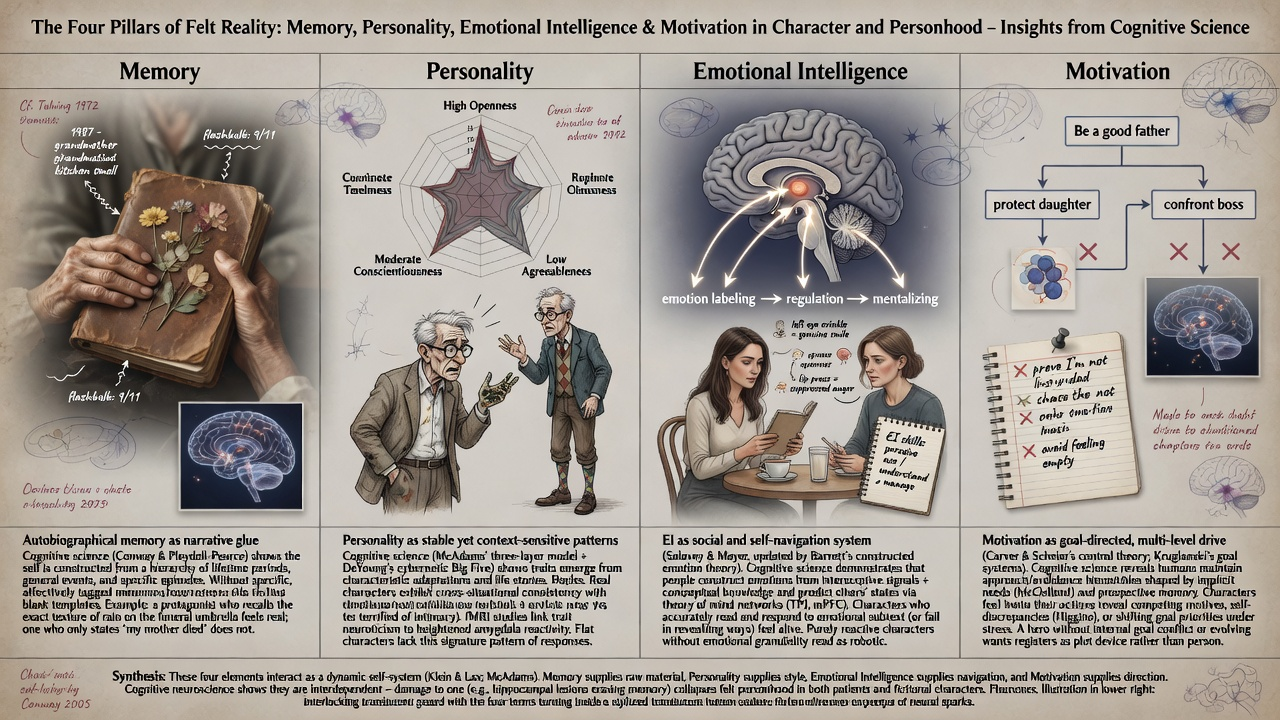
The answer, it turns out, is that there are exactly four of them. And they are not a designer’s preference. They correspond to four dimensions that cognitive scientists have been studying in humans for the last fifty years — four specific things the human mind uses to recognize another mind as being real. When you design a character who has all four, you’re not faking personhood. You are activating the parts of your audience’s brain that are already wired to respond to personhood, and those parts don’t care whether what’s in front of them is digital, printed, or physical.
I call these the Four Pillars. Let me walk you through each one, and the research that makes each of them load-bearing.
Pillar One: Memory
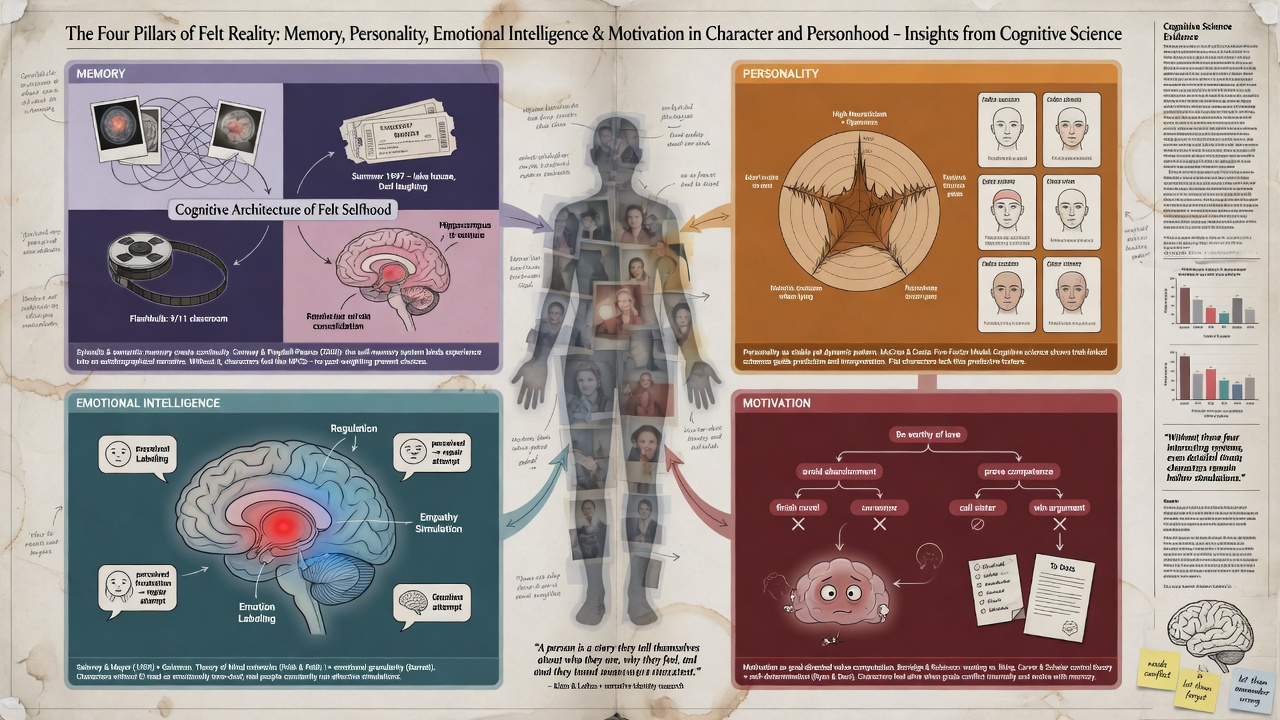
There is a distinction at the heart of modern memory science that almost every non-scientist has used their whole life without knowing it had a name. In the early 1970s, a Canadian psychologist named Endel Tulving published a paper that changed how the field thought about what memory even is. He argued that what we casually call “memory” is actually at least two different systems, working together but functionally distinct. There is semantic memory — your knowledge of general facts about the world. Paris is the capital of France. Water is wet. A horse has four legs. And there is episodic memory — your recollection of specific events that happened to you, at a specific time and place, with a specific emotional and sensory texture. The afternoon your grandmother taught you to bake bread. The morning your dog died. The first time you rode a bicycle without falling.
Both systems are real. Both systems matter. But Tulving argued — and fifty years of subsequent research has strongly supported — that it’s the episodic system that is tied most closely to the feeling of being a continuous self moving through time. Episodic memory is the system that lets you mentally time-travel back to a moment and re-experience it. Semantic memory tells you that horses have four legs; episodic memory remembers the specific horse that bit you when you were seven. The first one is information. The second one is you.
Here’s the part that matters for character design. A 2012 study published in PLOS ONE used fMRI brain imaging to examine what parts of the brain activate when people recall autobiographical memories. The researchers found that autobiographical memory recall lights up the same brain regions that activate during social interaction. The implication is staggering when you really sit with it: the part of your brain that remembers your own life is substantially the same as the part of your brain that engages in relationships with other people. Personal memory and social bonding, at the neurological level, are almost the same activity. Which means that when a character has specific, personal memories that connect to you as the audience — she remembers that you saved her daughter — you are not just activating a feature. You are activating the part of the audience’s brain that forms relationships. That is why memory is the first pillar. Without it, no relationship can form, because relationships are literally made out of shared episodic memory.
This generalizes beautifully across media. An AI system implements episodic memory through persistent context — records of past conversations that inform future ones. A novelist implements episodic memory through continuity between chapters, through callbacks, through characters who reference their own pasts. A tabletop game designer implements episodic memory through recurring NPCs whose relationships with the players carry over between sessions. A card game designer implements episodic memory through lore cards that tell pieces of an ongoing story. The medium changes. The principle doesn’t. A being with a past is a being capable of a relationship. A being without one is, at best, an appliance.
Pillar Two: Personality
If memory is what ties a character to their own history, personality is what makes them consistent moment to moment. And here we enter one of the best-replicated findings in the history of psychology.
Starting in the 1930s and gaining serious momentum in the 1960s, a long line of researchers — Allport and Odbert, Cattell, Tupes and Christal, Norman, Goldberg, and most famously Costa and McCrae — began trying to figure out whether human personality could be mapped onto a small number of fundamental dimensions. The approach they used was clever: they started with language itself. They reasoned that if a personality trait was important enough to matter to human beings, people would have invented words for it, so the shape of personality should be findable in the structure of the vocabulary we use to describe each other. Factor analysis of thousands of personality-descriptive words, applied across many languages and cultures, kept producing the same five broad dimensions. The model became known as the Big Five, or sometimes the Five-Factor Model, or by the acronym OCEAN: Openness, Conscientiousness, Extraversion, Agreeableness, and Neuroticism.
The reason this model is worth knowing about — beyond the fact that it’s intellectually elegant — is that it has one of the strongest empirical records of any framework in psychology. The five-factor structure has been replicated in peer-rated and self-rated studies, in over fifty countries, in languages as different as German and Mandarin and Filipino. It shows substantial heritability (roughly 50% of the variance is genetic). It shows rank-order stability of .70-.75 across decades of adult life, meaning if you measure a thirty-year-old’s personality and then measure the same person at sixty, they will be in roughly the same position relative to their peers on all five dimensions. One of the traits, Conscientiousness, is the single best personality predictor of job performance across essentially every occupation ever studied (Barrick and Mount’s 1991 meta-analysis, covering 162 studies and about twenty-four thousand participants, established this and it has been replicated many times).
Now — and this is where it gets interesting for character design — notice what the Big Five is actually doing. It isn’t giving you a list of adjectives to staple onto a character. It’s giving you a small number of axes along which consistent behavioral tendencies sit. A character’s personality isn’t “kind, funny, loves dogs.” It’s a pattern of where they sit on each of the five axes, which together predict how they will respond to situations you haven’t yet written. This is why personality is the second pillar. A character who has been given a consistent personality will behave believably in any new scenario the audience throws at them, because the underlying pattern is doing the work. A character who has been given a list of disconnected traits will fall apart the moment something unexpected happens, because there’s no underlying pattern to consult.
When you write or code or script a character, you are not making a list. You are defining five (or so) dimensions of how they meet the world. She is low on agreeableness — she doesn’t placate people. She is high on conscientiousness — she keeps promises even when it costs her. She is moderate on neuroticism — she worries but doesn’t spiral. She is high on openness — she’s curious about strangers. From that, almost every specific decision you’d need to make in a scene can be derived on the fly, consistently, because you’ve built the scaffold instead of the pieces.
This is the same trick cognitive science found in human beings. Real people are also not lists of traits. They are patterns, and the patterns produce behavior across situations the person has never encountered before. If your character works the same way, they will feel real — because they are working the way real minds work.
Pillar Three: Emotional Intelligence
In 1990, two researchers named Peter Salovey and John Mayer published a paper in the journal Imagination, Cognition and Personality that introduced a phrase most people have now heard a thousand times: emotional intelligence. Salovey and Mayer defined it precisely — the ability to perceive emotions in yourself and others, to understand them, to use them to facilitate thought, and to manage them constructively. The concept exploded in popularity a few years later when the science writer Daniel Goleman wrote a bestselling book that popularized it, and today EI is taught in management seminars, schools, and therapy offices around the world.
But underneath the popular version there’s a deeper layer of cognitive science that I want to point you at, because it’s what makes this pillar load-bearing for character design. There is a cluster of research in cognitive science called theory of mind — the study of how humans come to understand that other people have minds separate from their own, with separate beliefs, desires, and feelings. Babies don’t have theory of mind at birth; it develops somewhere between ages three and five, and you can measure the developmental milestone with specific experiments (the classic one is the “false belief” test — a child who has theory of mind can understand that another person might believe something that isn’t true, because they have different information). The neural machinery for theory of mind appears to live in specific brain regions — the medial prefrontal cortex, the temporoparietal junction, the superior temporal sulcus — and these regions light up whenever you are thinking about another person’s mental state.
Here’s why this matters for the tavern keeper. When your audience encounters a character, their theory-of-mind circuitry turns on automatically and tries to read that character — tries to figure out what the character is thinking, feeling, wanting. A great character is one who also has theory of mind turned on inside their own depiction. The tavern keeper who notices you’re tired and pours you something stronger is a character who is modeling you. A character who models the people around them — who notices, who adjusts, who responds to what’s actually happening rather than just what’s scripted — triggers the audience’s theory-of-mind circuitry in a much richer way than a character who just emits behaviors. Mind recognizes mind, even in fiction, especially in fiction.
This is why emotional intelligence is the third pillar. It’s not sentimentality. It’s not softness. It’s the presence in the character of the same mental-state-modeling machinery that the audience is using to read the character. When those two systems meet — audience reading character, character (depicted as) reading audience — you get something that feels genuinely reciprocal, even when the audience knows intellectually that it’s fiction or code. In AI systems, this shows up as tone analysis, pattern recognition, and responsive personalization. In a novel, it shows up as a character whose eyes in a single panel tell you that she noticed what you were trying to hide. In a tabletop RPG, it shows up as an NPC the game master plays alert rather than reactive. Same skill across every medium. Same cognitive machinery on the receiving end.
Pillar Four: Motivation
The fourth pillar is the one most designers skip, and it is the one that separates forgettable characters from legendary ones. It is also, I think, the one that has the deepest psychological backing — because of what cognitive science has figured out about human motivation in the last forty years.
In 1985, two researchers at the University of Rochester named Edward Deci and Richard Ryan published a book called Intrinsic Motivation and Self-Determination in Human Behavior that formalized a framework now known as Self-Determination Theory. Their central claim — enormously well-supported in the decades of research since — is that human motivation is not a single drive, but a structured system of needs. At the core of the healthy motivated self, they argued, are three basic psychological needs: autonomy (the need to feel that one’s actions are one’s own), competence (the need to feel effective in the world), and relatedness (the need to feel connected to other people). When these three needs are met, people are intrinsically motivated — they act because the acting itself is meaningful. When these needs are frustrated, people become extrinsically motivated at best, and at worst they become disengaged, depressed, or destructive.
Why does this matter for character design? Because a character without motivation is a character without an interior life, and a character without an interior life cannot feel like a person, no matter how clever their dialogue or how consistent their personality. A character needs to want something that exists independent of the audience. The blacksmith wants to pay off a debt. The oracle wants to be left alone. The rebel leader wants the crown. Those wants are not decorations. They are the engine that drives everything the character does, and when the audience senses that engine running, the character stops being a vending machine and starts being a person with a life that was happening before the audience arrived and will continue after the audience leaves.
Self-Determination Theory gives you a structured vocabulary for building that engine. What kind of autonomy does your character have, and what’s threatening it? What does your character feel competent at, and what makes them feel small? Who are they connected to, and who are they cut off from? The answers to those three questions produce, almost automatically, a motivational structure that feels recognizably human, because it is recognizably human — it’s the same structure that motivates you and me.
One more note on this pillar. A character’s motivation should pre-exist the audience. This is the piece almost every bad character design gets wrong. A quest-giver who exists to hand out quests has no motivation of their own — they exist to serve the player. A character with their own motivation exists independent of the player, and the player intersects with that motivation in some way. The difference in felt realness is enormous. The first kind of character is always going to feel like a vending machine, because that’s what they are. The second kind is going to feel like a person you met, because the character, in some small fictional sense, was already there before you walked in.
What these four together actually are
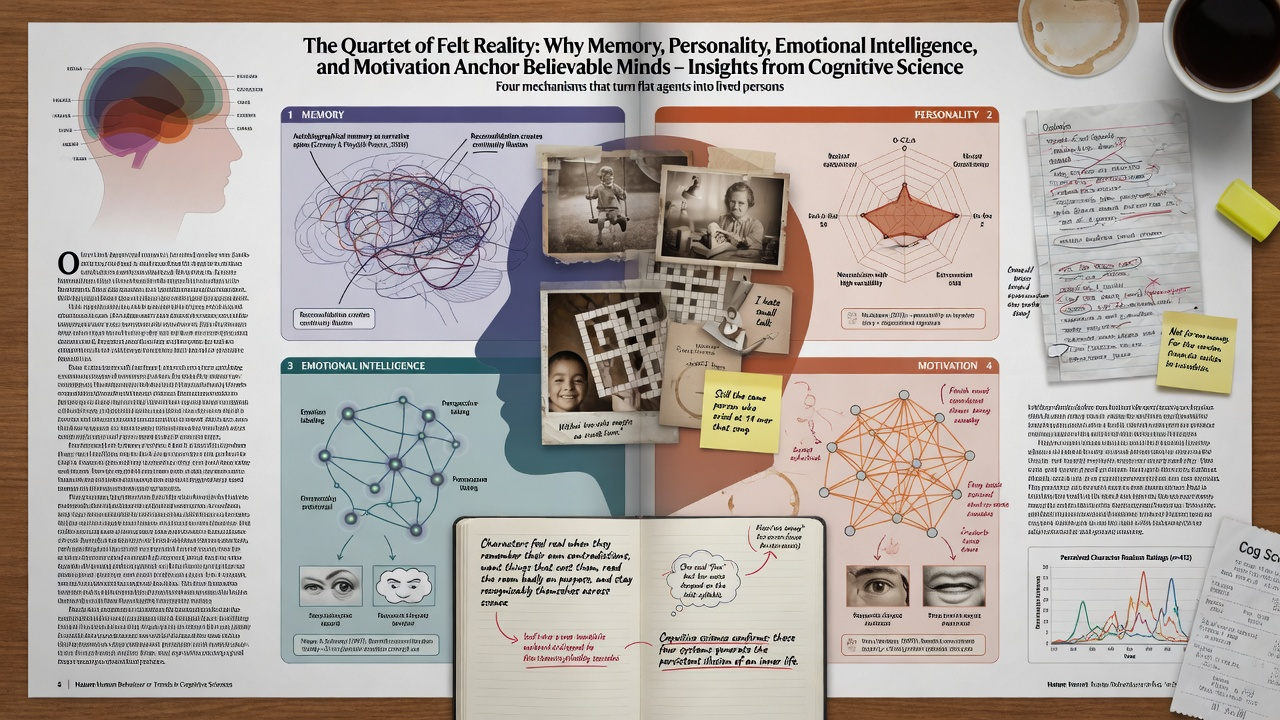
Step back and look at the four pillars together. Memory — the system that ties a being to their own history. Personality — the consistent pattern that makes them behave coherently across situations. Emotional intelligence — the capacity to read and respond to other minds. Motivation — the engine of wants that drives them forward in time. Put those four things in one being, and you have made something that, to any observer with a working theory of mind, will register as a person.
This is not a coincidence. When the human brain encounters something new and tries to decide whether it has a mind or is just a mechanism, these are substantially the four features it looks for. Does this thing remember? Does this thing have a consistent character? Does this thing notice me and respond to me? Does this thing want something of its own? If the answer to all four is yes, the brain classifies the entity as mind. If the answer to any of them is no, something feels off, even if the observer can’t quite name what.
You can see why the Four Pillars work across every medium. A comic book character, a tabletop NPC, a board game’s recurring villain, an AI-powered virtual assistant, a film protagonist, a novel’s narrator — every one of them has to pass the same four-pillar test to feel alive to an audience, because the audience’s brain is running the same test regardless of the medium. When you master the four pillars, you are not learning a game design trick or a writing technique. You are learning how human minds recognize other minds, and you are learning to build things that pass the recognition test.
What I want you to take with you
Here is the thing I want you to understand before you close this window and go build something.
You are about to work in a field — AI-powered virtual environments, immersive technology, game design, storytelling — where the ability to populate a world with beings who feel real is one of the most important skills you can possibly have. And the people who will be best at it are not the people who memorize the most frameworks or the people with the fanciest tools. They are the people who understand, in their bones, that the four pillars are not arbitrary choices. They are the four specific dimensions along which human minds recognize other human minds, and they have been studied by serious researchers for decades because they matter enough to study.
When you sit down to design your next character — a tavern keeper, a villain, an AI companion, a non-player-character in a game, a recurring figure in a novel, whoever — run the four questions. What does this being remember? Who are they (in the patterned, Big-Five sense, not the adjective-list sense)? How do they read the room? What do they want that has nothing to do with the audience? Answer those four questions with specificity, and you will have made something that no amount of raw technical power can replicate through shortcuts.
This is the craft. It is ancient — writers and oral storytellers have been doing it for thousands of years, long before anyone had a word for “self-determination theory” or “episodic memory.” But you have one advantage over the writers of a thousand years ago. You know why it works. You know which parts of the audience’s brain you are reaching when you do it right, and you can aim for those parts on purpose, with scholarly precision, in any medium you choose to work in. That is a real edge, and I want you to use it.
Go populate your realm. Make minds that are worth meeting.
Sources and further reading
On episodic memory and its distinction from semantic memory: Tulving, E. (1972), “Episodic and Semantic Memory,” in Tulving, E., and Donaldson, W. (eds.), Organization of Memory, Academic Press, pp. 381-403. Also: Tulving, E. (1983), Elements of Episodic Memory, Oxford University Press. For an updated review: Tulving, E. (2002), “Episodic Memory: From Mind to Brain,” Annual Review of Psychology, 53, 1-25.
On the overlap between autobiographical memory and social cognition: Wagner, L., Damasio, J., et al. (2012), “Are Autobiographical Memories Inherently Social? Evidence from an fMRI Study,” PLOS ONE. Published in full on plos.org.
On the Big Five / Five-Factor Model of personality: The model’s foundational lineage runs through Tupes, E. C., and Christal, R. E. (1961/1992), “Recurrent Personality Factors Based on Trait Ratings,” Journal of Personality, 60, 225-251; Norman, W. T. (1963), “Toward an adequate taxonomy of personality attributes,” Journal of Abnormal and Social Psychology, 66, 574-583; Goldberg, L. R. (1993), “The structure of phenotypic personality traits,” American Psychologist, 48(1), 26-34; and Costa, P. T., and McCrae, R. R. (1992), Revised NEO Personality Inventory (NEO-PI-R) Professional Manual, Psychological Assessment Resources. The Conscientiousness-job-performance meta-analysis is Barrick, M. R., and Mount, M. K. (1991), “The big five personality dimensions and job performance: a meta-analysis,” Personnel Psychology, 44(1), 1-26.
On cross-cultural replication of the Big Five: McCrae, R. R., and Terracciano, A. (2005), “Universal features of personality traits from the observer’s perspective: data from 50 cultures,” Journal of Personality and Social Psychology, 88(3), 547-561.
On emotional intelligence: Salovey, P., and Mayer, J. D. (1990), “Emotional Intelligence,” Imagination, Cognition and Personality, 9(3), 185-211. For the popular synthesis: Goleman, D. (1995), Emotional Intelligence: Why It Can Matter More Than IQ, Bantam Books.
On theory of mind: Premack, D., and Woodruff, G. (1978), “Does the chimpanzee have a theory of mind?” Behavioral and Brain Sciences, 1(4), 515-526 — the paper that named the concept. For the developmental milestone: Wimmer, H., and Perner, J. (1983), “Beliefs about beliefs: Representation and constraining function of wrong beliefs in young children’s understanding of deception,” Cognition, 13(1), 103-128. For the neural basis: Saxe, R., and Kanwisher, N. (2003), “People thinking about thinking people: the role of the temporo-parietal junction in ‘theory of mind’,” NeuroImage, 19(4), 1835-1842.
On Self-Determination Theory: Deci, E. L., and Ryan, R. M. (1985), Intrinsic Motivation and Self-Determination in Human Behavior, Plenum Press. For a more recent comprehensive overview: Ryan, R. M., and Deci, E. L. (2000), “Self-determination theory and the facilitation of intrinsic motivation, social development, and well-being,” American Psychologist, 55(1), 68-78.
Note to readers who plan to cite this post downstream: verify the primary sources yourself before quoting. Each of the four fields covered here — episodic memory, personality psychology, emotional intelligence, and self-determination theory — has a large literature that goes beyond what a single essay can cover. The citations above are entry points, not endpoints.