FORGE: A Five-Step Method for Thinking in the Age of AI

Building on the SIFT method with a framework designed for a generation that uses AI to find the truth, not just to question it.

Suggested citation: Denney, D. W. (2026). FORGE: A five-step method for thinking in the age of AI. Realm Forge Academy Research. Published May 12, 2026. https://apps.dwdenney.com/forge-method

License and use: This research is published openly and freely. Journalists, researchers, educators, and students are welcome to read, reference, cite, and build upon this work with proper attribution using the citation above.


The method that got us here

In 2017, a digital literacy researcher at Washington State University named Mike Caulfield introduced a framework he called the Four Moves, later formalized as the SIFT method — Stop, Investigate the Source, Find Better Coverage, Trace Claims to their Origin (Caulfield, 2017; 2019). SIFT was designed as a fast, practical alternative to the older CRAAP test (a checklist-based evaluation method that had been the default in academic libraries for years). Where the CRAAP test asked students to evaluate a source in isolation — currency, relevance, authority, accuracy, purpose — SIFT asked them to leave the source and check what the rest of the web said about it. The technique Caulfield called “lateral reading” was borrowed directly from professional fact-checkers, and it worked.

SIFT became, and remains, one of the most widely adopted information literacy frameworks in higher education. It is taught in university libraries from Chicago to Carleton. It has a Creative Commons license, a companion course, and a substantial body of classroom adoption behind it. I want to be direct about this: SIFT is good work. It does what it was designed to do, and what it was designed to do is important. The emotional pause. The source investigation. The upstream tracing. These are genuine skills, and Caulfield deserves credit for distilling them into a framework simple enough to teach in a single class session.

But SIFT was designed for a specific information landscape — the landscape of 2017, where the primary threat was misinformation spreading through social media, and the primary question was “should I believe this?” The landscape has changed. The threats have changed. And the tools available to the person doing the evaluating have changed in ways that SIFT, through no fault of its own, does not address.

This post introduces FORGE — a five-step framework that builds on SIFT’s foundation and extends it for a generation that lives in a world SIFT wasn’t built for.

Continue reading FORGE: A Five-Step Method for Thinking in the Age of AI
Five Thousand Years to Get Here

A brief history of every tool humanity ever built to teach its children — and the one that finally broke the pattern.

By D.W. Denney


Every tool on the same curve

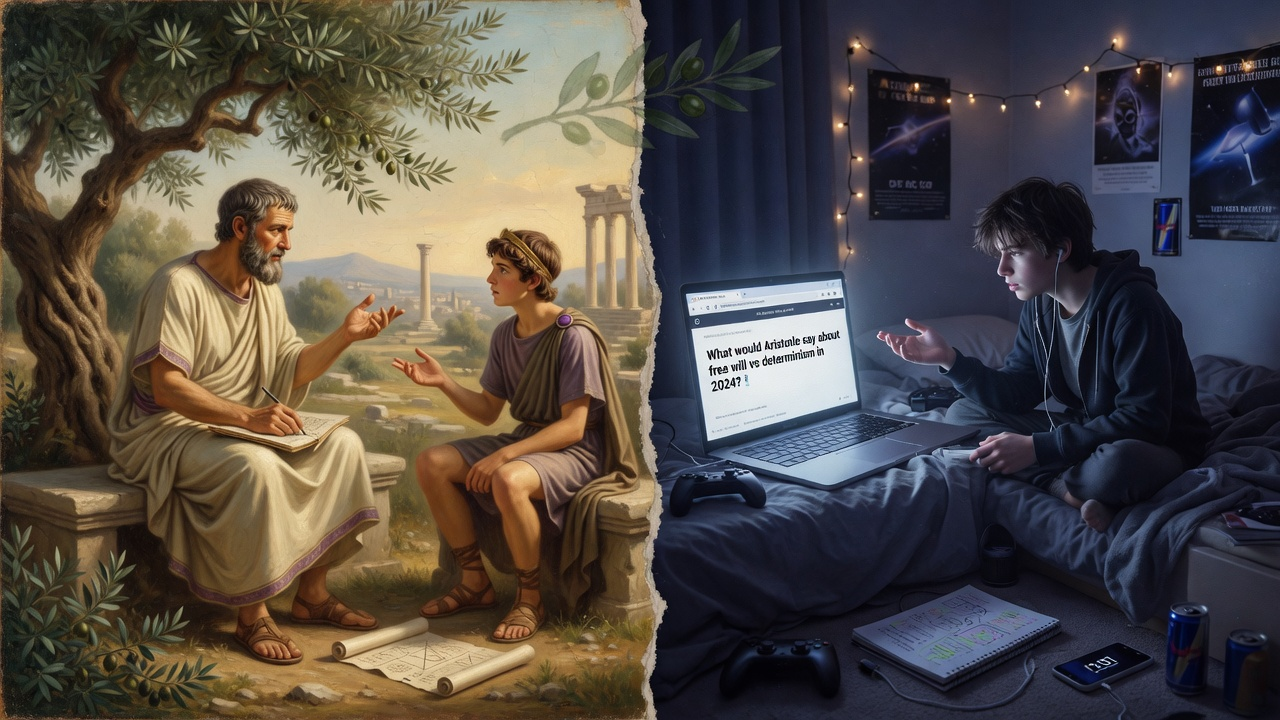
I want to tell you a story that covers five thousand years and fits on the back of a napkin. It’s the story of every educational technology humanity has ever invented, and the punchline is that until very recently, they were all doing the same thing.

Here’s the napkin version. Somebody knows something. They need to get it into somebody else’s head. Every tool we’ve ever built for that purpose — every single one, across all of recorded history — has been a more efficient way to do one of four things: store information, distribute information, drill information into memory, or assess whether the information stuck. That’s it. Four functions. Five millennia. One curve.

Let me walk you through the timeline, and watch how the technology changes while the function doesn’t.

Oral tradition. Before writing, knowledge lived in the mouths of elders and was transferred by speech. The teacher spoke. The student listened, repeated, and memorized. If the elder died before the transfer was complete, the knowledge died with them. The storage medium was the human brain. The distribution method was the human voice. The range was the distance sound carries across a campfire. This worked, and it worked for a long time, and the stories and songs and genealogies that survived this era are a testament to how powerful the human memory can be when it has no other option. But the system was fragile. One forgotten line, one dead elder, one scattered tribe, and the knowledge was gone.

Continue reading Five Thousand Years to Get Here

Realm Forge Academy: Forging the Future of Education with Modern Tools and Purpose-Driven Pedagogy

By D.W. Denney


The education landscape is shifting. Traditional four-year degrees are pricing out the very people who need them most, while the industries shaping our future — immersive technology, artificial intelligence, blockchain, game development, spatial computing — are evolving faster than any institution can keep up with. Meanwhile, aspiring creators and builders are left choosing between crushing debt and being left behind.

Realm Forge Academy was built to solve that problem.

Build Worlds. Not Debt.

That’s not just a tagline. It’s a promise — and it’s the founding principle behind everything we do at RFA.

Continue reading Realm Forge Academy: Forging the Future of Education with Modern Tools and Purpose-Driven Pedagogy

🔮✨ The Architecture of Wonder: Understanding Magic Systems in Fantasy

By Professor DeeDubs | Realm Forge Academy


When we watch a wizard cast a spell in our favorite fantasy story, something magical happens beyond the fictional incantation itself. We either lean forward, invested in whether the magic will work—or we lean back, sensing that the author will simply make whatever happens most convenient for the plot. The difference between these two experiences isn’t luck or talent alone. It’s architecture.

Fantasy author Brandon Sanderson has articulated a framework for thinking about magic systems that has quietly revolutionized how creators approach the fantastical. His observations—often called “Sanderson’s Laws of Magic”—aren’t rules to be followed rigidly, nor are they secrets known only to published authors. They’re learnable principles that help us understand why some magical moments leave us breathless while others leave us shrugging.

More importantly, they’re tools you can use in your own creative work.

Continue reading 🔮✨ The Architecture of Wonder: Understanding Magic Systems in Fantasy