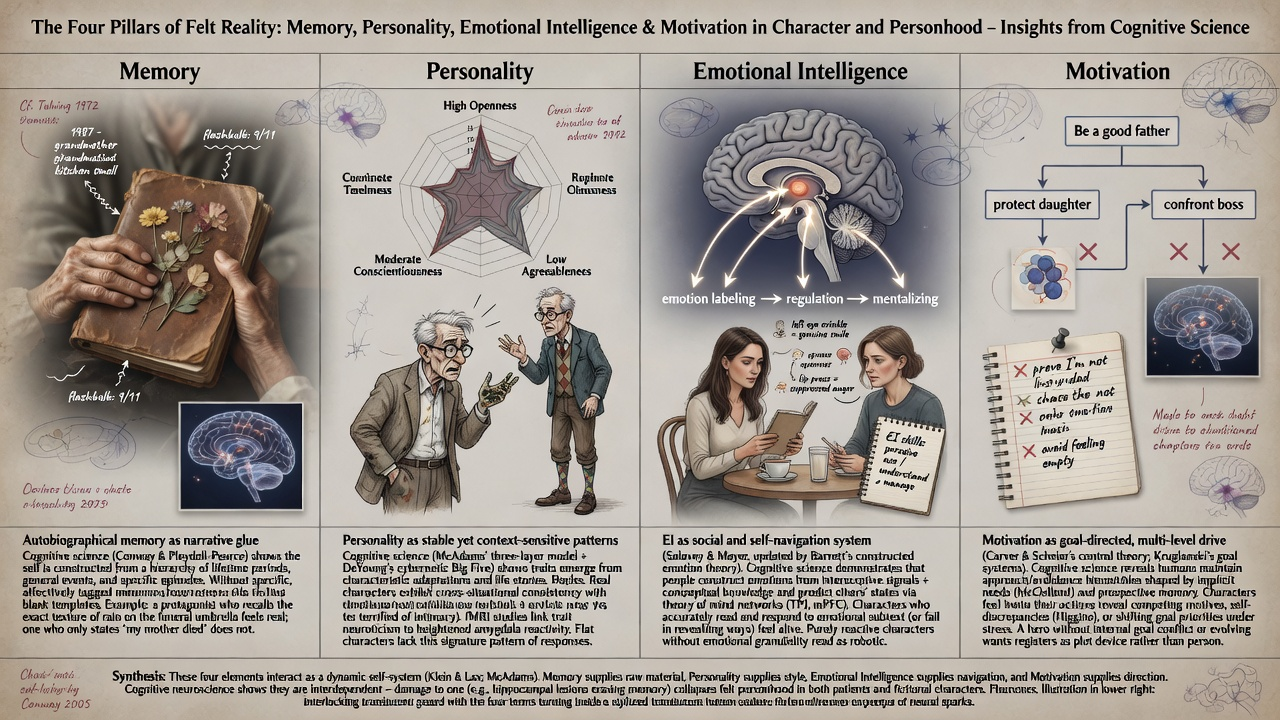
A scholarly look at why memory, personality, emotional intelligence, and motivation are the four things that make a character — or a person — feel real. And what cognitive science has to say about each of them.
The tavern keeper problem
Picture two tavern keepers. Both are characters in a game you’re playing, or in a novel you’re reading, or in an immersive world you’ve been invited to spend time in. Both pour you a drink, both take your coin, both say hello when you walk in.
The first one does nothing else. Every time you walk into the tavern, she gives you the same greeting. She doesn’t remember you. She doesn’t react to whether you saved her village last week or betrayed it. She has no opinions about the weather, no complaints about her back, no idea that the barrel of ale in the corner is cursed. She is, functionally, a vending machine for drinks wearing a person-shaped costume.
The second tavern keeper is also a character. Also pours drinks, also takes coin, also says hello. But she remembers that you helped her daughter recover from the fever six months ago, and her greeting is warmer because of it. She’s naturally cautious — when you ask about the cursed barrel, she weighs the question for a moment before answering, the way a cautious person would. She notices that you look tired tonight and pours you something a little stronger without being asked. And she wants something for herself, too, underneath all of this — she’s been saving up to buy out her brother-in-law’s share of the tavern, because she thinks she could run it better alone, and that ambition colors everything she does.
You know which tavern keeper is the memorable one. You also know which one is more expensive and time-consuming to build, whether you’re writing her as a novelist, scripting her as a game designer, or configuring her as an AI system. The question I want to walk through in this post is why. Why does the second one feel like a person and the first one doesn’t? What are the specific ingredients that have to be present for a character to cross the line from puppet into presence?
The answer, it turns out, is that there are exactly four of them. And they are not a designer’s preference. They correspond to four dimensions that cognitive scientists have been studying in humans for the last fifty years — four specific things the human mind uses to recognize another mind as being real. When you design a character who has all four, you’re not faking personhood. You are activating the parts of your audience’s brain that are already wired to respond to personhood, and those parts don’t care whether what’s in front of them is digital, printed, or physical.
I call these the Four Pillars. Let me walk you through each one, and the research that makes each of them load-bearing.
Continue reading The Four Pillars of a Mind