The science of why people grieve when their Minecraft house burns down, trade favors with strangers they’ve never met in person, and develop inside jokes about things that never happened in the real world.
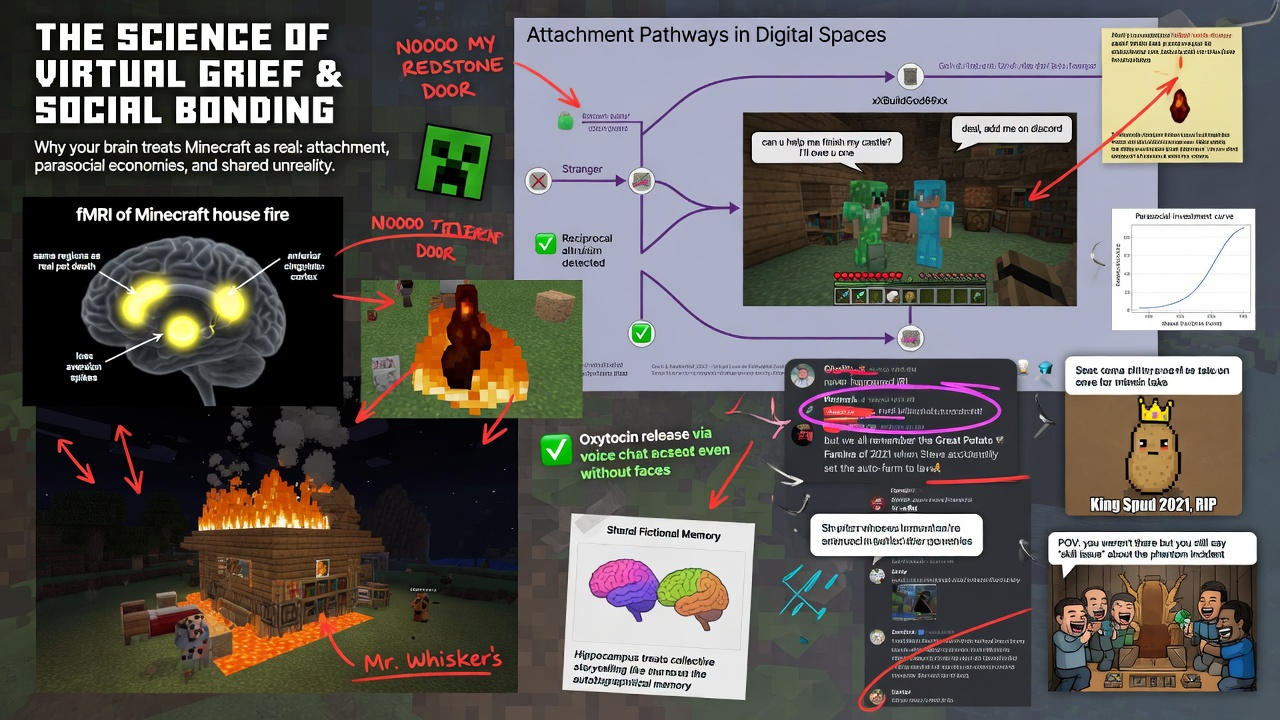
A house that isn’t there
Let me tell you about something that happens all the time and that almost nobody takes seriously. Somebody builds a house in a video game. A digital structure, made of digital blocks, sitting on a digital plot of land that exists only as data on a server somewhere. They spend hours on it — maybe weeks. They choose the materials carefully. They place the windows where the light comes in right. They build a little garden out back, because the garden makes it feel complete. The house is not real. It cannot be lived in. It has no value on any market that deals in physical objects.
And when somebody griefs it — when some other player comes along and burns it down or blows it up for laughs — the person who built it feels a surge of anger and loss that is, by any honest measure, real. Not metaphorical. Not exaggerated. The feeling is genuinely comparable, in both quality and intensity, to the feeling of having something physical vandalized. They feel violated. They feel robbed. Some of them log off and don’t come back.
Every experienced gamer knows this. Most people outside of gaming dismiss it. But there is a growing body of research in psychology, neuroscience, and behavioral economics that says the gamers are right and the dismissers are wrong — and that the feelings people develop about virtual places, virtual objects, and virtual communities are not pale imitations of “real” feelings. They are the same feelings, running on the same psychological machinery, triggered by the same mechanisms. The virtual village feels like home because your brain is using the same hardware to process it that it uses to process your actual home.
I want to walk you through four pieces of that research, because they map almost perfectly onto four dynamics that make virtual communities work. And if you’re somebody who designs virtual worlds for a living — or wants to — understanding these dynamics is not optional. They are the difference between building a world people visit and building a world people belong to.
Piece One: The IKEA Effect, or Why Labor Is Love
In 2012, three researchers — Michael Norton at Harvard, Daniel Mochon at Yale, and Dan Ariely at Duke — published a paper with one of the best titles in behavioral economics: “The IKEA Effect: When Labor Leads to Love.” Their experiments were simple. They asked one group of participants to assemble IKEA furniture and another group to inspect pre-assembled versions of the same furniture. Then they asked both groups how much they’d be willing to pay for the item. The builders were willing to pay 63% more for a product that was, by any objective standard, identical. In a follow-up experiment with origami, the builders valued their own amateur paper cranes — crinkled, lopsided, objectively terrible — nearly as highly as expert-made origami.
The finding was robust and has since been replicated across different products, populations, and contexts. A 2026 meta-analysis aggregating 55 studies and over 5,000 participants confirmed a significant moderate effect. The underlying mechanism, the researchers argued, is something psychologists call psychological ownership — the feeling that something is mine not because I purchased it but because I made it. When you invest effort into creating something, a part of your identity gets bound up in the object. The thing you built becomes, in psychologist Russell Belk’s famous phrase from his 1988 paper, part of your extended self. Destroying it doesn’t just destroy an object. It damages a piece of who you are.
Now map that onto virtual worlds. When a player spends forty hours building a house in a game, every hour is a deposit into the psychological-ownership account. Every block placed, every roof tile adjusted, every garden planted is labor, and the labor is generating love — the same love that makes a wobbly IKEA bookshelf feel like a masterpiece. When the house burns down, it’s not “just a game.” It’s the destruction of something the builder’s identity was invested in, and the pain is real because the IKEA effect is real, and it does not check whether the object it’s operating on is made of wood or pixels.
This is the first design lesson: if you want people to belong to your world, give them something to build in it. Not just something to buy or collect. Something to labor over, something that requires time and decisions and care. The labor is the bond. The bond is the belonging.
Piece Two: The Favor Economy, and Why Strangers Become Neighbors
Here is something that happens in every successful virtual community, and it happens fast. Two players who have never met in person and who live on opposite sides of the planet start doing favors for each other. “I’ll gather stone for your house if you craft tools for my workshop.” Within a few exchanges, they feel an obligation to each other that has nothing to do with contractual enforcement and everything to do with an ancient piece of social machinery.
The machinery is called reciprocity, and it is one of the most studied phenomena in social psychology. Robert Cialdini, in his influential 1984 book Influence, identified reciprocity as one of the six fundamental principles of human social behavior. The principle is simple: when someone does something for you, you feel a powerful internal pressure to do something for them in return. This pressure is not optional. It is not a personality trait that some people have and others don’t. It is, as far as the research can tell, a species-wide feature of human social cognition, documented in every culture that has been studied. The anthropologist Marcel Mauss, writing all the way back in 1925 in The Gift, argued that gift exchange — the cycle of giving, receiving, and repaying — is the foundational mechanism of social bonding in human societies. Without reciprocity, there are no obligations. Without obligations, there are no relationships. Without relationships, there is no community.
Virtual communities rediscover this principle independently, every time, without anyone teaching it to them. The player who gathers stone for your house has created an obligation in you. The obligation feels real because it is real — it’s running on the same reciprocity machinery that Mauss documented in Polynesian gift economies a century ago. The digital medium is new. The psychology is ancient. And the communities that form around dense networks of mutual obligation are remarkably resilient, because every favor exchanged is another thread in the web that holds the group together.
The design lesson here is: build systems that make it easy for players to help each other, and make the help visible. Trade systems, crafting dependencies, shared building projects where one person’s contribution is visible to the others. Every exchange is a thread. Enough threads make a net.
Piece Three: The Legend of the Flood, and Why Shared Memories Make Groups
Every community that lasts long enough develops its own folklore. “Remember when Sarah accidentally flooded the entire village?” “Remember the night the server crashed during the dragon fight and we all thought our saves were gone?” “Remember when the new kid built a castle that was so ugly the whole guild voted to pretend it didn’t exist?” These stories are told and retold, and each retelling strengthens the group.
This is not just a charming social quirk. It is a documented phenomenon in social psychology called collective memory, and the research on it goes back to Maurice Halbwachs, a French sociologist writing in the 1920s and 1930s, who argued that memory is not just an individual act but a fundamentally social one. We remember together. The stories we tell each other about our shared past are not just records of events — they are active constructions that produce group identity. When you can say “we” and have the other person know which “we” you mean, and which stories belong to that “we,” you have a group. When you can’t, you don’t.
More recent research has confirmed and extended Halbwachs’ insight. Work on transactive memory systems — a term coined by Daniel Wegner in 1985 — shows that groups develop shared memory structures in which different members hold different pieces of the group’s knowledge. “Ask Marcus about the resource prices, he tracks that stuff.” “Ask Leah about the eastern boundary, she mapped it last month.” The group’s total knowledge exceeds what any single member knows, and each member knows who knows what. This division of memory labor creates interdependence, and the interdependence creates belonging. You are not just in the group because you like the people. You are in the group because the group’s memory literally has a slot in it that only you fill.
Virtual communities are spectacularly good at generating collective memory, often better than physical communities, because the events that happen in virtual worlds are unusual enough to be memorable and shared enough to be communal. Nobody has a good story about last Tuesday at the office. Everybody has a good story about the time the guild wiped on the final boss six times in a row and then beat it at 3 AM while someone’s baby was screaming in the background. The vividness and emotional intensity of shared virtual experiences produces memories that are dense with the exact features Tulving identified as characteristic of strong episodic memory: specific time, specific place, specific sensory and emotional texture. The memories stick because they feel like things that happened to you, even though they happened inside a game.
The design lesson: design for memorable failure as much as memorable success. The stories that bind a community are not the stories of everything going right. They are the stories of everything going hilariously, catastrophically wrong, and the group surviving it together. If your world is too smooth, too predictable, too optimized, it won’t generate the folklore that makes a community cohere. Leave room for the flood.
Piece Four: The Gift That Arrives While You Sleep
Here is the last piece, and it’s the one that is most specific to virtual communities and most underappreciated by people who design them.
In the physical world, collaboration requires co-presence. If you and I are building a barn together, we have to be standing in the same field at the same time. This is a hard constraint, and it limits the size and resilience of any collaborative project to the number of people who can be in the same place at the same moment.
Virtual worlds abolish this constraint. A player in Tokyo logs off after placing the foundation stones of a new market hall. A player in London logs on three hours later and adds the walls. A player in São Paulo logs on after that and adds the roof. When the Tokyo player logs back in the next morning, the market hall is finished, and nobody was ever in the same “room” at the same time. The building grew while each of them slept.
This is called asynchronous collaboration, and it has a specific psychological effect that is different from synchronous teamwork. When you log in and find that someone has continued your work — has taken the thing you started and added to it, carefully, in a way that shows they understood what you were building — you experience something that is very close to the feeling of being cared for. Someone was thinking about you, or at least about your project, while you were asleep. Someone saw what you were doing and decided it was worth continuing. That is a profound social signal, and it operates below the level of conscious analysis. You don’t think “how nice, someone added walls to my foundation.” You feel that the community is alive, that it persists even when you’re not watching, that there is a continuous effort larger than any one person’s contribution and you are part of it.
Robin Dunbar’s research on social network structure is relevant here. Dunbar, a British anthropologist, proposed in the 1990s that human social groups organize into a layered structure with specific sizes — roughly 5 intimate friends, 15 close friends, 50 good friends, 150 meaningful acquaintances. These layers have been confirmed in studies of real-world communities, telephone calling patterns, social media behavior, and — notably — online multiplayer game environments. The fractal structure appears to be the same online and off. What virtual communities add to the picture is a new mechanism for maintaining the outer layers of the network: asynchronous contribution. In the physical world, maintaining 150 relationships requires enormous amounts of face-to-face time, which is why most people don’t actually sustain a full Dunbar’s-number network. In virtual worlds, the act of contributing to a shared project while someone else is asleep counts as a relationship-maintenance event, even though no face-to-face interaction occurred. The contribution is the contact. The wall you added to my building is a social signal that keeps our thread alive.
The design lesson: make asynchronous contributions visible. When a player logs in and finds that others have continued their work, the system should make it easy to see who contributed and what they added. A build log. A notification. A visible signature. The contribution is a social act, and social acts need to be seen to do their bonding work.
What all four of these have in common
Step back and look at the four dynamics together. Psychological ownership through labor. Reciprocity through exchange. Group identity through shared memory. Community persistence through asynchronous collaboration. Each of them is doing the same underlying thing: it is taking a mechanism that was designed into the human mind for living in physical communities and activating it in a digital context.
This is why your virtual village feels like home. Not because you’re confused about what’s real. Not because you’re addicted. Not because you don’t have “real” friends. It feels like home because the psychological machinery of belonging doesn’t check the medium. It checks the inputs. Did I build something here? Do I owe someone and do they owe me? Do we share stories that only we understand? Is the community still going when I’m not watching? If the answers are yes, the belonging is real, because the machinery that produces belonging has been fed the inputs it was made to process.
This has implications for anyone building virtual worlds, and the implications are not small. If you understand these four dynamics, you can design for them on purpose — and when you design for them on purpose, you are not manipulating people into fake belonging. You are creating the conditions under which real belonging can form, using the same psychological architecture that has been producing communities since the first human beings decided to build something together and remember it afterward.
What I want you to take with you
If you are going to build worlds — virtual, augmented, tabletop, narrative, any kind — you are in the belonging business whether you know it or not. Every design decision you make is either creating the conditions for belonging or failing to create them. A crafting system that lets players depend on each other is a reciprocity engine. A building system that lets players invest labor is an IKEA-effect engine. A world that generates unexpected, memorable, shared catastrophes is a collective-memory engine. A project log that shows who contributed while you were asleep is a community-persistence engine.
None of these are accidents in the communities where they work. They are design, even if the designers didn’t always know the research behind why it worked. Now you know. You have the vocabulary and the scholarly grounding to build these dynamics on purpose, to defend your design decisions with research, and to understand why your players feel the way they feel about the things you make for them.
Build something worth belonging to. The research says they will.
Sources and further reading
On the IKEA effect: Norton, M. I., Mochon, D., and Ariely, D. (2012), “The IKEA Effect: When Labor Leads to Love,” Journal of Consumer Psychology, 22(3), 453-460. Also: Pelled, L., et al. (2026), “Labor Leads to Love, Right? A Meta-Analysis of the IKEA Effect,” Psychology & Marketing (Wiley), synthesizing 55 studies (N=5,454) confirming a significant moderate effect (d=0.57).
On the extended self and psychological ownership: Belk, R. W. (1988), “Possessions and the Extended Self,” Journal of Consumer Research, 15(2), 139-168. For a contemporary review: Peck, J., and Shu, S. B. (2023), “A review and future avenues for psychological ownership in consumer research,” Consumer Psychology Review (Wiley).
On reciprocity as a principle of social bonding: Cialdini, R. B. (1984), Influence: The Psychology of Persuasion, William Morrow. The anthropological foundation: Mauss, M. (1925), The Gift: Forms and Functions of Exchange in Archaic Societies (English translation: 1954, Cohen & West).
On collective memory: Halbwachs, M. (1925), Les cadres sociaux de la mémoire (The Social Frameworks of Memory). For the transactive memory concept: Wegner, D. M. (1985), “A computer network model of human transactive memory,” paper presented at the 93rd meeting of the American Psychological Association.
On Dunbar’s number, social network layers, and their replication in online gaming environments: Dunbar, R. I. M. (1992), “Neocortex size as a constraint on group size in primates,” Journal of Human Evolution, 20, 469-493. Also: Fuchs, B., et al. (2014), documenting Dunbar’s fractal social layers in online multiplayer game environments. For a recent review: Dunbar, R. I. M. (2024), “The social brain hypothesis — thirty years on,” Annals of Human Biology.
Note to readers: verify the primary sources yourself before quoting. Several of these fields are under active revision, and the most important thing about a scholarly blog post is that it points you toward the research, not that it replaces it.