How real builders work with experts in fields they’ll never master — and why that’s the whole point.

A confession to start with
Let me tell you about a thing that happens to almost every builder I’ve ever met, including me.
You get an idea. A good one. The kind of idea that makes you sit up a little straighter in your chair, open Claude in a new browser tab and start sketching on the back of a receipt. And then, about ninety seconds in, a little voice shows up and says:
“Who do you think you are? You don’t know anything about that.”
And the idea dies right there, on the back of the receipt, because the voice sounds reasonable. You don’t know anything about medicine. You don’t know anything about aerospace. You don’t know anything about education theory or marine biology or whatever the idea was touching. So clearly you have no business building anything near it. Right?
Wrong. And I want to spend the next few minutes showing you exactly why — using one of the coolest examples I know.
The example: VR surgery training
Imagine you’re an expert in virtual reality. You can build a convincing simulated space. You know how to track a controller, how to render a scene at ninety frames per second without making anyone throw up, how to design an interaction loop that actually feels like picking something up instead of fumbling in the dark. You are, by any reasonable standard, really good at VR.
Now imagine you want to build a VR training system for surgeons. Not a game. A real one. The kind that teaches a human being how to cut into another human being without killing them.
Here’s the voice again: “Are you out of your mind? You’ve never even taken an anatomy class. You don’t know a scalpel from a spatula. You’d hurt somebody.”
Okay. Let’s actually look at that objection, because even though it sounds smart, the truth is the exact opposite.
The part nobody tells you about the people building these things
There’s a company called Osso VR. They build surgical training simulators — the real deal, used by more than a hundred thousand healthcare professionals around the world. If you wanted to point to a success story in VR medical training, theirs is near the top of the list.
Here’s the interesting part. Osso VR was co-founded by a man named Justin Barad. Dr. Barad is a pediatric orthopedic surgeon, UCLA and Harvard trained. He knows exactly what it feels like to hold a bone saw. He knows the failure modes, the complications, the moments where a resident’s hands betray them. He knows surgery the way you know whatever it is you know best.
Do you know what he doesn’t know how to do? Build a VR headset application from scratch. Write the shader code. Optimize the physics engine so the tissue deforms believably without tanking the frame rate. That’s not his world. That was never going to be his world. He has spent the hours of his life becoming a surgeon, and he can’t also have them back to go become a graphics programmer.
So what did he do? He found the other half. He partnered with engineers. Together they built something that neither of them could have built alone, and a hundred thousand surgeons are better trained because of it.
Let that sink in for a second. A Harvard surgeon — a guy you and I might both be tempted to put on a pedestal and mumble around nervously — needed partners who knew things he didn’t. The surgeon needed the VR people. He wasn’t embarrassed about it. He wasn’t ashamed. He just went and found them, because he understood his limits and didn’t let his pride or fears get the best of him.
The reversal nobody shows you
Here’s the thing I really want you to see, and I want you to see it clearly, because it’s the whole point of this post.
You already assumed the surgeon was “the smart one” in that partnership. You assumed the VR engineers were lucky to be in the room. I bet you assumed it without even noticing you were assuming it, because that’s how we’ve been trained to think about doctors versus everybody else.
But from the surgeon’s side of the table, it looks exactly the opposite. From where Dr. Barad was sitting, the VR engineers were the wizards. They could do things he had no idea how to do. They spoke a language he didn’t speak. They were the ones with the mysterious deep knowledge, and he was the guy asking questions and trying to keep up with the vocabulary.
Both things were true at the same time. He was in over his head on their stuff. They were in over their heads on his stuff. And neither of them was embarrassed about it, because they both understood something that the little voice in your head is trying to hide from you:
Nobody holds both halves. That’s not a bug. That’s how every interesting thing ever gets built.
The surgeon isn’t going to learn shader programming to your level. You’re not going to learn surgery to his. And that’s fine. That’s good. That’s the arrangement. Two people, each deep in their own thing, meeting at a shared problem that neither of them could touch on their own.

What this is actually called (because there’s a whole science to it)
Turns out this isn’t just a nice feeling. It has a name. A bunch of names, actually, because people have been studying it for decades.
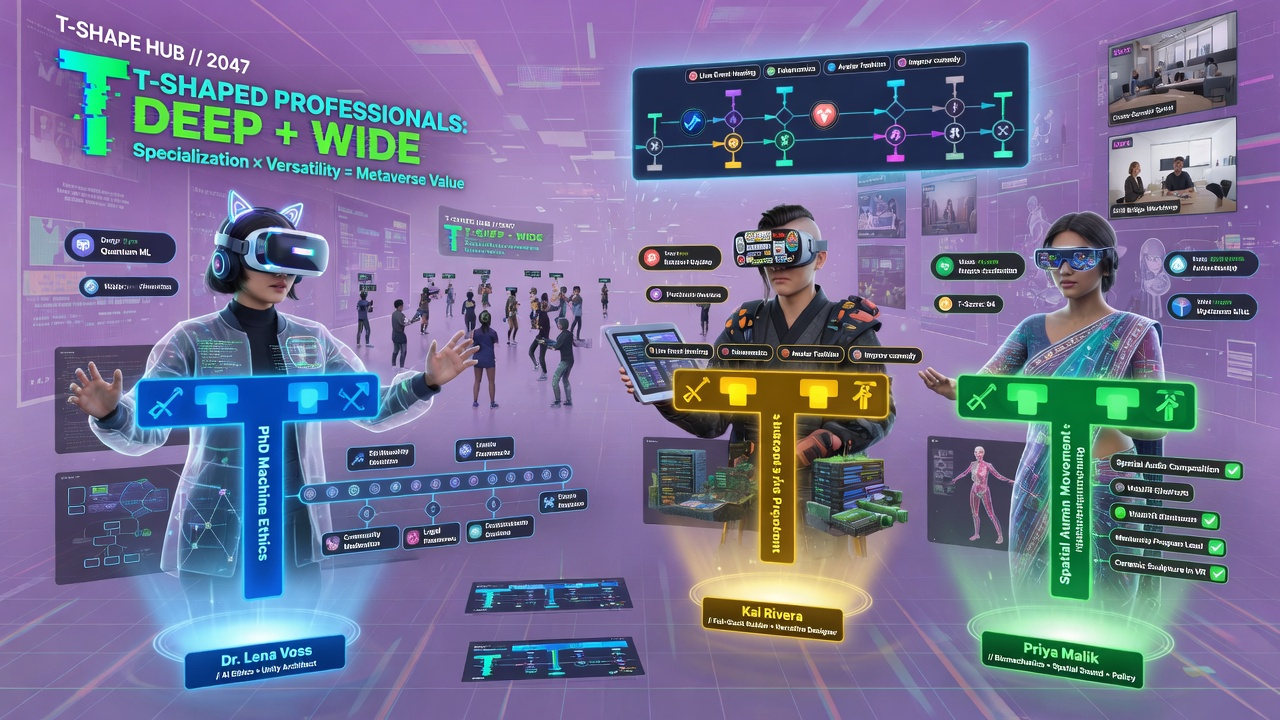
The most common one you’ll hear is the T-shaped professional. The idea goes like this: imagine the letter T. The vertical line is your deep expertise — the one thing you know all the way down to the bedrock. The horizontal line across the top is your ability to reach sideways and work with people whose vertical lines are planted in totally different ground. You don’t need to be deep in their field. You just need enough of the horizontal bar to hold a conversation, ask good questions, and understand their answers well enough to build something together.
The concept has been kicking around since the 1980s, when McKinsey started using it to talk about consultants, and it got picked up by IDEO — the design firm behind a lot of famous products — as the way they actually hire people. Their founder David Kelley put it like this: they look for people who are “so good at what they do that they can extend beyond it.” Not people who know everything. People who know one thing so well that they’re secure enough to walk into a room full of strangers and learn.
There’s another name for the magic that happens in those rooms. A writer named Frans Johansson called it the Medici Effect, after the family in Renaissance Florence who brought together sculptors, scientists, poets, and philosophers and watched the whole Renaissance kind of catch fire in their living room. His point was that the big breakthroughs almost never happen inside a field. They happen at the intersections — where a sculptor is standing next to an anatomist and they notice something neither of them would have noticed alone.
That’s where you want to be. At the intersection. And the only way to get there is to walk in holding your one good thing and trusting that somebody on the other side of the table is walking in with theirs.
“But how do I even talk to them?”
Okay, practical question. You’ve decided you want to build the VR surgery trainer. You’ve found a surgeon who’s willing to talk to you. You sit down across the table from her. Now what?
Here’s what I want you to internalize before that meeting: you are not there to pretend you know surgery. You are not there to impress her with medical vocabulary you crammed the night before. She will see through that in about four seconds, and worse, it’ll actually make her trust you less, because now she has to wonder what else you’re faking.
What you’re there to do is much simpler and much more powerful. You’re there to ask good questions and listen carefully to the answers. That’s it. That’s the whole job in that meeting.
Good questions sound like this:
- “Can you walk me through what a trainee typically gets wrong the first ten times they try this?”
- “What does it feel like in your hands when it’s going right? What does it feel like when it’s going wrong?”
- “If you could show a resident one thing in a simulator that you can’t show them any other way, what would it be?”
- “What are the things experienced surgeons know that nobody ever writes down?”
Notice what those questions have in common. They aren’t asking her to teach you surgery. They’re asking her to teach you what matters about surgery for the thing you’re building together. That’s a completely different request, and it’s one she can actually answer in a reasonable amount of time, because it’s about her experience, not about a textbook.
And here’s the beautiful part. While she’s answering, you’re going to notice something. She’ll start describing problems that sound like VR problems. “I wish they could feel the difference between healthy tissue and the bad stuff.” That’s a haptics problem, and you know a lot about haptics. “I wish I could show them what it looks like when they’re about to nick the wrong artery.” That’s a visualization problem, and you know a lot about visualization. “I wish we could run the same scenario twenty times without burning through twenty cadavers.” That’s literally the thing VR is best at in the whole world.
You didn’t need to know surgery to hear those problems. You just needed to know your own craft well enough to recognize a shape you could work with when somebody described it to you.
The grown-up science of knowing you got it right
Here’s one more thing I want to give you, because it’s going to matter later and because it’s honestly kind of cool.
When researchers build things like VR surgical trainers for real, they don’t just ship them and hope. They run studies to prove the trainer actually works. And the framework they use has these beautifully boring names that hide something important. I’ll give you four of them, and I promise this isn’t going to turn into a lecture.
Face validity just means: does this thing look and feel right to an expert? You put a surgeon in the headset and she says “yeah, that’s about what the operating room feels like.” That’s face validity. It’s the easiest one to get and the least rigorous, but it’s where you start.
Content validity asks: are the right things in there? Did you include the steps that actually matter, in the right order, with the right decision points? This is where your surgeon partner is worth her weight in gold, because she’s the one who can tell you what’s missing.
Construct validity is the cool one. It asks: can the simulator tell the difference between a beginner and an expert? If you put ten residents and ten senior surgeons through it, do the senior surgeons score better? If they don’t, something is wrong with what you’re measuring. If they do, you’ve built something that actually reflects skill.
Predictive validity is the hardest and the most important. It asks: do people who train on this thing actually do better in the real operating room? That’s the whole game. If the answer is yes, you’ve built a real tool. If the answer is no, you’ve built a very expensive video game.
I’m not teaching you this so you can pass a test. I’m teaching you this so that the next time somebody tells you “you can’t build that, you don’t have the credentials,” you know in your bones that there is a real, proven, published methodology for proving whether a thing works, and that methodology is available to you too. It isn’t locked behind a medical degree. It’s locked behind the willingness to do the work and partner with the people who can help you do it right.
What I really came here to tell you
Okay. Let me drop the VR stuff for a minute and talk to you directly.
I’ve met a lot of smart, talented people in my life who never built the thing they wanted to build because somewhere along the way, somebody made them feel small. Maybe it was a teacher. Maybe it was a kid in the hallway who was better at being loud than being right. Maybe it was a whole building full of kids who decided early on who got to be “smart” and who didn’t, and you weren’t on the list. Maybe nobody ever said it to your face and you just picked up the signal anyway, the way kids do.
And now you’re older and you have an idea, and that old signal is still in there, humming away, telling you that you’re not the kind of person who gets to build things in serious fields. That the serious fields are for the serious people and you’re not one of them and you should stick to whatever you were supposed to stick to.
I want you to hear me clearly: that signal is lying to you. It was lying to you then and it’s lying to you now. The world is not divided into serious people and unserious people. It is divided into people who built the thing and people who let the voice win.
The people who built the thing were not less scared than you. They were not smarter than you in some cosmic, permanent way. They were people who knew one thing well and were brave enough to walk into a room and say “I need your help with the other thing.” That is the whole secret. That’s the whole game. You already have the first half of it, or you’re working on it, which is the same thing.
And when you’re ready — when you’ve got your one good thing, and you meet somebody who has theirs — you’re going to sit down at a table together and something is going to start happening between you that is bigger than either of you alone. You’re both going to feel a little out of your depth. You’re both going to feel a little like the other one is the real expert in the room. You’re both going to be right, and you’re both going to be wrong, and the thing you build together is going to be something neither of you could have made by yourself.
That’s not a consolation prize for people who aren’t good enough to go it alone. That is how the good stuff has always been made. That is how the Renaissance happened, and how the moon landing happened, and how Osso VR happened, and how every single thing you love about the modern world happened. Two people, or ten, each holding their one good thing, leaning across a table toward a shared problem.
Pull up a chair. There’s a seat for you.
This post accompanies a lesson in the Realm Forge Academy curriculum. If you’re reading it and feeling something stir — that’s not an accident. That’s the part of you that already knew.