A short tour of the measurable effects haptic feedback has on the human nervous system — and one unintended consequence nobody planned.
By D W Denney (Professor DeeDubs)
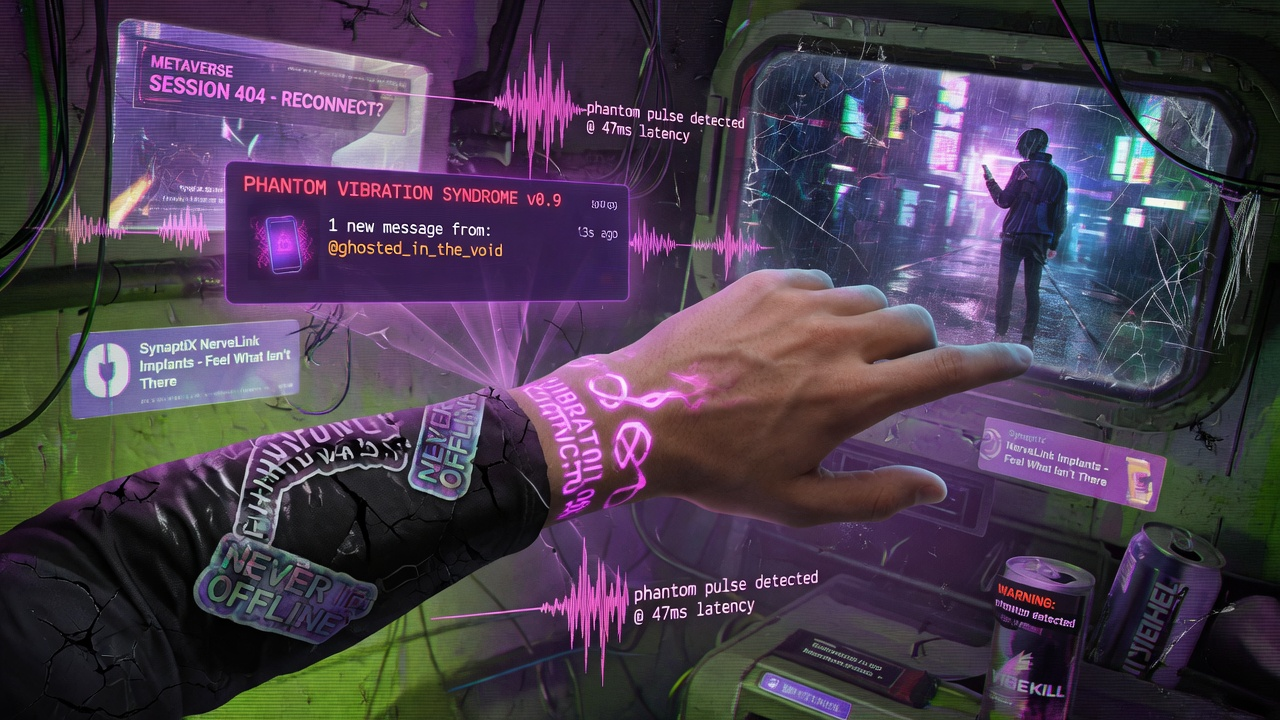
A haptic buzz feels like nothing. A tiny tremor against your skin, barely worth noticing, gone in a fraction of a second. It is the smallest, cheapest kind of feedback a device can give you. And yet, under a scientist’s microscope, that tiny tremor turns out to be doing surprising work on the inside of you — work that reaches into your motor control, your perception of reality, and even your experience of pain. Let me show you three things the research has nailed down, and one thing it’s still figuring out.
One: It makes you faster and more accurate
If you add a small haptic confirmation to a button press — a tiny buzz when you tap a key on a touchscreen, for example — users make fewer mistakes and respond faster than they do with visual or audio cues alone. The effect has been documented across typing, aviation controls, surgical training interfaces, and mobile phone keyboards. The effect is biggest when the user’s eyes and ears are already busy with something else, which is exactly why cockpits and operating rooms were among the first places to adopt haptic feedback seriously. A pilot who is watching the horizon cannot also watch a screen. A surgeon whose eyes are on a patient cannot also glance at a dial. A well-placed buzz reaches them on a channel that is not already full.
The lesson is simple but easy to miss. Haptic feedback is not decorative. It is a performance enhancer for the user’s body, and the enhancement is real and measurable.
Two: It rewrites how real something feels
Here is where it gets strange. There is a research area called pseudo-haptics, pioneered by a French group led by Anatole Lécuyer starting in the mid-2000s, that studies what happens when you pair a visual with even a crude vibration. The finding is consistent and a little unsettling: users report the virtual object feels heavier, rougher, more textured, more present than it has any right to feel, given how simple the actual haptic signal is. The brain is not waiting for a high-fidelity reproduction of the real thing. The brain is so eager to believe touch information that it will construct a whole imagined texture out of a single well-timed buzz.
This is not a flaw. This is your nervous system doing what it was carefully made to do — integrate sparse information into a coherent picture of the world. A good haptic designer is not trying to recreate reality. They are giving the brain a small hint and letting the brain do the rest. The buzz is a suggestion. The reality is constructed by the user, on the fly, from almost nothing. That’s remarkable, and it’s a superpower a good builder can learn to use on purpose.
Three: It can measurably reduce pain
This is the one most people don’t know about, and it is my favorite. In 1965, two researchers named Ronald Melzack and Patrick Wall published a paper in Science proposing what they called the gate control theory of pain. The idea was that pain signals and touch signals travel up the spinal cord on different kinds of nerve fibers, and when enough touch and vibration signals are firing, they can effectively crowd out the pain signals at a gate in the dorsal horn of the spinal cord. The brain only gets one summary signal, and the summary is dominated by whichever channel is louder. A good loud vibration can drown out a sharp pain the same way a loud song can drown out a quiet one.
This is not theoretical. There is a commercial medical device called Buzzy, designed for pediatric injections, that exploits exactly this mechanism. You strap it to a kid’s arm before the needle goes in, it vibrates, and the perceived pain of the shot drops dramatically. Published studies on Buzzy and similar devices report pain reductions in the range of 50 to 80 percent on standard rating scales. A 2016 study of vibration during cosmetic facial injections dropped pain scores from 4.5 to 2.3 on a ten-point scale — a massive effect, and the patients were adults, not kids.
A well-designed haptic cue, in other words, is not just giving you information. It is reaching into a real neurological gate in your spinal cord and partly closing it. That is a shockingly powerful thing for a small buzz to do, and nobody outside the medical device world talks about it nearly enough.
And one thing the research is still figuring out
Here is where I want to end, because it is the part that should make any thoughtful builder slow down and pay attention.
If haptic feedback can measurably improve your reaction time, rewrite your perception of a virtual object, and even partially block your pain signals at the level of the spinal cord — all from a tiny buzz — then it should not be surprising that the nervous system treats haptic input as something important, and starts learning patterns it is exposed to repeatedly.
There is a phenomenon called phantom vibration syndrome that has been studied in heavy-smartphone-use populations since 2010. The clinical name is a tactile hallucination: the user perceives a buzz in their pocket when the phone did not actually buzz. In a longitudinal study of medical interns, the rate climbed during the most intense months of their training and dropped back down weeks after their internship ended. The effect tracks with exposure. The nervous system is learning the pattern, running it in the background, and occasionally firing it when reality didn’t.
You may have experienced this yourself. You may not have. The important thing is not whether it happens to everybody — it doesn’t — but what its existence tells us. It tells us that haptic patterns, repeated often enough, leave traces in the nervous system that persist when the device is off. Nobody designed phantom vibrations on purpose. They are the downstream consequence of making something your first three effects ignored: time. Haptics that are powerful enough to do what we saw in the first three sections are also powerful enough to do things nobody planned for, given enough hours.
What I want you to take from this
A buzz is never just a buzz. When you add haptic feedback to something you’re building, you are reaching into the motor control system, the perception system, and the pain system of every user who touches it. You are doing real work on the inside of them, whether you meant to or not.
That is not a warning. That is an invitation. The same science that lets a haptic interface speed up a surgeon or calm an anxious child before a shot is waiting for the next generation of builders to put it to use in places nobody has thought of yet. There is enormous room for good work here, and the work is not just engineering — it is a kind of quiet collaboration with how the human body was carefully made to process the world. Understand the three effects. Respect the fourth. Build with both hands open.
The next buzz you design might do more than you think.
This post accompanies a lesson on haptic feedback in the Realm Forge Academy curriculum. Try the haptics in the next device you use — a phone, a controller, a VR rig — and notice what it does to your body that you hadn’t noticed before. That noticing is the beginning of the skill.